
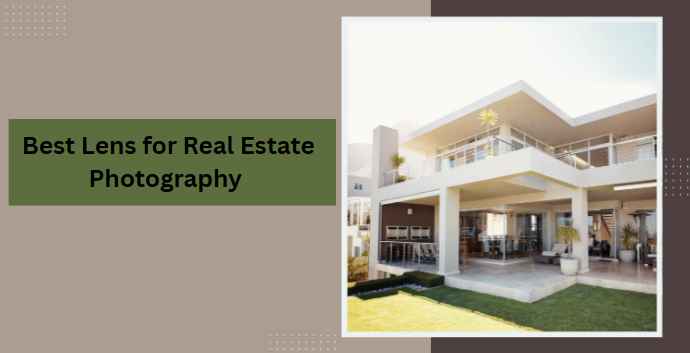
High-quality property images help showcase rooms, highlight architectural details, and create a positive first impression. Choosing the best lens for real estate photography can make a significant difference in how a home or commercial property looks in photographs.
Whether you are a professional real estate photographer, a property agent, or a beginner, the right lens can help you capture spacious interiors, beautiful exteriors, and detailed property features.
Why Choosing the Right Lens Matters
A standard lens may not capture the entire space when you cannot move farther away from the subject.
A suitable wide-angle lens allows photographers to include more of a room in a single frame. It can make property layouts easier to understand and help viewers appreciate the relationship between different areas.
However, best lens for real estate photography an extremely wide lens can distort walls, furniture, and room proportions. The goal is to capture an inviting image while keeping the property looking realistic.
ALSO READ Choosing the right https://trndzoo.com/keywords-for-real-estate/#more-473
Best Lens for Real Estate Photography Wide-Angle Options
Wide-angle lenses are popular among property photographers because they capture more of the scene than standard lenses.
best lens for real estate photography For many full-frame cameras, focal lengths between 16mm and 24mm provide a useful starting point for interior photography. A 16mm lens can capture tight spaces, while a 20mm or 24mm lens may produce more natural-looking room proportions.
Photographers best lens for real estate photography using APS-C cameras should account for the crop factor. For example, a 10mm to 18mm lens can provide a similar field of view to a wide-angle lens on a full-frame camera, depending on the camera’s crop factor.
Prime Lenses vs. Zoom Lenses
best lens for real estate photography Both prime and zoom lenses can produce excellent real estate photographs, but they serve different needs.
Prime Lenses
best lens for real estate photography Prime lenses have a fixed focal length. They are often sharp and may offer wider maximum apertures. A 20mm or 24mm prime lens can be useful for photographers who prefer a simple setup and consistent image quality.
The main disadvantage is that you cannot change the focal length without changing lenses or moving your position.
Zoom Lenses
For property photographers who work in different room sizes, a wide-angle zoom is often a practical and versatile choice.
Important Features to Consider
1. Focal Length
best lens for real estate photography Focal length determines how much of a scene the lens captures. Wide focal lengths are useful for interiors, while longer focal lengths can highlight details such as fireplaces, decorative finishes, and architectural features.
Choose a lens that provides enough coverage without making rooms appear unnaturally stretched.
2. Aperture
Aperture controls how much light enters the camera. Although a wide maximum aperture is helpful in low-light photography, real estate photographers often use a tripod and smaller apertures, such as f/8, to achieve sharp images across a room.
A best lens for real estate photography lens that performs well at common working apertures is generally more important than having an extremely wide maximum aperture.
3. Distortion Control
Lens distortion can cause straight architectural lines to appear curved or bent. Look for lenses with good optical correction and compatible distortion-correction profiles. Keeping the camera level also helps preserve straight vertical lines.
4. Sharpness and Image Quality
Sharp images allow viewers to see textures, finishes, and design features clearly. Compare independent reviews to assess center and edge sharpness, especially when photographing entire rooms.
best lens for real estate photography Good lighting, accurate focus, and careful camera positioning also contribute significantly to image quality.
Recommended Lens Types for Different Cameras
The best choice depends on your camera system and budget.
best lens for real estate photography Explore compatible 10–18mm or 10–20mm lenses.
Micro Four Thirds cameras:
A best lens for real estate photography compatible wide-angle zoom around 7–14mm may be suitable.
Budget setups:
A best lens for real estate photography standard kit zoom with a sufficiently wide focal length can work for larger rooms while you learn composition and lighting.
These are general focal-length recommendations rather than a single universal product choice. Always check camera compatibility before purchasing.
Tips for Better Real Estate Photography
best lens for real estate photography Even the best lens cannot replace good photographic technique. Use a tripod to keep your camera stable and maintain consistent framing. Photograph rooms from corners when appropriate, but avoid positioning the camera so close to furniture that it appears disproportionately large.
best lens for real estate photography Keep vertical lines straight by leveling the camera and using a tilt-shift lens when your workflow or budget justifies one. Correct minor perspective and lens distortion during editing without exaggerating room dimensions.
best lens for real estate photography Use natural light when available, and balance interior and window exposure carefully. Before taking photographs, remove unnecessary clutter, arrange furniture, and open curtains to make the property look welcoming.
Conclusion
Selecting the best lens for real estate photography depends on your camera, shooting environment, budget, and preferred style. Wide-angle lenses are especially useful for interiors, while zoom lenses provide flexibility across different property types.
Combine it with a tripod, careful composition, good lighting, and realistic editing to create professional property images that help buyers understand the space.
FAQs
- What is the best lens for real estate photography?
A wide-angle lens is generally a strong choice. For full-frame cameras, a 16–35mm zoom is a versatile option for capturing interiors and architectural details.
- Is a 16mm lens good for real estate photography?
Yes. A 16mm lens on a full-frame camera can capture small rooms and wide interiors, although careful composition is necessary to avoid exaggerated proportions.
- Is a 24mm lens wide enough for property photography?
A 24mm lens can work well in larger rooms and for exterior photography. However, it may not capture an entire small bathroom or narrow room.
- Should I use a prime or zoom lens?
A zoom lens offers greater flexibility when photographing rooms of different sizes. A prime lens can be an excellent option when you prefer a fixed focal length and a simpler setup.
- What aperture is best for real estate photography?
Many photographers use apertures around f/8 to achieve good sharpness across the scene. The ideal setting depends on lighting, depth of field, and the lens being used.
- Do I need an expensive lens for real estate photography?
No. A compatible budget wide-angle lens can produce good results. Lighting, composition, camera stability, and editing are also important.
- Can I use a kit lens for real estate photography?
Yes, if the kit lens is wide enough for the rooms you photograph. However, a dedicated wide-angle lens may provide more coverage in tight spaces.
- Why do wide-angle property photos look distorted?
Wide-angle lenses can exaggerate perspective when objects are close to the camera. Keep the camera level, position it carefully, and correct lens distortion during editing when necessary.
1 thought on “Best Lens for Real Estate Photography : A Complete Guide for Stunning Property”